How to Prepare for Coding Interview with AI: Complete 2026 Guide
Learn a responsible AI-assisted workflow for DSA, system design, coding mocks, graduated hints, transcript review, and clearer technical explanations.
Coding interviews can feel disconnected from everyday development. You may be expected to recognise an algorithm quickly, write correct code without your usual tools, explain every decision, and stay composed while someone evaluates you. In the HackerRank 2025 Developer Skills Report, 74% of developers said landing a tech job was difficult, while 78% said assessments did not align with real-world tasks.
Learning how to prepare for coding interview with AI can make that process more focused. An AI assistant can run mock interviews, provide graduated hints, review explanations, and expose gaps faster than passive study. It should not become a substitute for independent problem-solving.
This guide explains a practical workflow for using InterviewGPT across DSA, system design, project discussions, and behavioural questions. You will learn what to do before, during, and after each practice session, plus how to reduce AI support as interview day approaches.
Ready to practise? Download InterviewGPT, configure your target role, and start with 10 free minutes.
Table of Contents
- Understanding modern coding interviews
- How AI interview assistants work
- Step-by-step InterviewGPT guide
- Top 10 InterviewGPT features for coding interviews
- Common coding questions and AI-assisted practice
- Pro tips, dos, and don'ts
- Illustrative practice scenarios
- AI-assisted vs traditional preparation
- Frequently asked questions
Understanding Modern Coding Interviews
Most technical hiring processes assess more than whether your final code runs. Interviewers want to see how you understand an unfamiliar problem, clarify ambiguity, choose a suitable data structure, discuss trade-offs, test edge cases, and communicate under pressure.
The most common rounds are:
- Data structures and algorithms: Arrays, strings, hash maps, linked lists, trees, graphs, recursion, sorting, searching, and dynamic programming.
- System design: Designing a scalable service, defining APIs and data models, estimating capacity, and discussing reliability or security trade-offs.
- Practical coding: Debugging, extending an existing codebase, writing an API, or completing a take-home task.
- Project and technical discussion: Explaining architecture decisions, production incidents, ownership, and measurable impact.
- Behavioural interview: Demonstrating communication, collaboration, leadership, and learning through specific examples.
A strong answer usually follows a visible process: clarify the task, describe a simple solution, improve it, write readable code, test it, and explain complexity. That process matters because a correct answer reached silently can be harder to evaluate than an imperfect answer supported by clear reasoning.
Preparation is also changing. HackerRank reports that 62% of developers feel forced to overprepare for algorithm-heavy assessments, while 66% prefer practical coding challenges. A better coding interview preparation India strategy is not simply solving more questions. It is practising the exact skills you will need to demonstrate: pattern recognition, communication, testing, and recovery when stuck.
How to Prepare for Coding Interview with AI Assistants
An AI interview assistant combines several technologies into one workflow. With permission, it can transcribe microphone and system audio, identify the question being discussed, and send relevant context to an AI model. Screen analysis can help interpret visible code, errors, diagrams, or problem statements. Resume, role, company, and custom-instruction inputs make responses more relevant.
For practice, this creates a useful feedback loop:
- You attempt the problem independently.
- The assistant gives a hint, explanation, or alternative approach.
- You test the suggestion and explain it in your own words.
- You review the transcript and retry without help.
AI is especially useful when you do not have a study partner available. It can challenge assumptions, generate edge cases, simulate follow-up questions, or ask you to justify complexity. However, AI output can be incomplete or wrong. Treat it like an unverified reviewer, not an answer key.
Privacy and Ethics
Before recording or analysing any conversation, understand the employer's policy and obtain any required consent. Some companies allow AI tools in daily engineering work but prohibit them during assessments. Others may design an explicitly AI-enabled interview.
The safest rule is simple: use AI freely for preparation; use it live only when explicitly allowed. Practise without assistance regularly so you can prove your own ability. HackerRank's guidance on assessment integrity also emphasises designing and following clear AI policies rather than assuming every use is acceptable.
Step-by-Step Guide to Using InterviewGPT for Coding Interviews
InterviewGPT works best when you use it as a structured coaching system, not as a last-minute shortcut.
Before the Interview
Start with a baseline mock interview without assistance. Pick one medium-difficulty problem, set a 40-minute timer, record your explanation, and score yourself on problem understanding, approach, correctness, testing, and communication. This reveals whether you need more work on concepts or on interview execution.
Next, build a focused practice plan. Group questions by reusable patterns such as two pointers, sliding window, prefix sum, binary search, graph traversal, and dynamic programming. Add system design and behavioural practice if the role requires them.
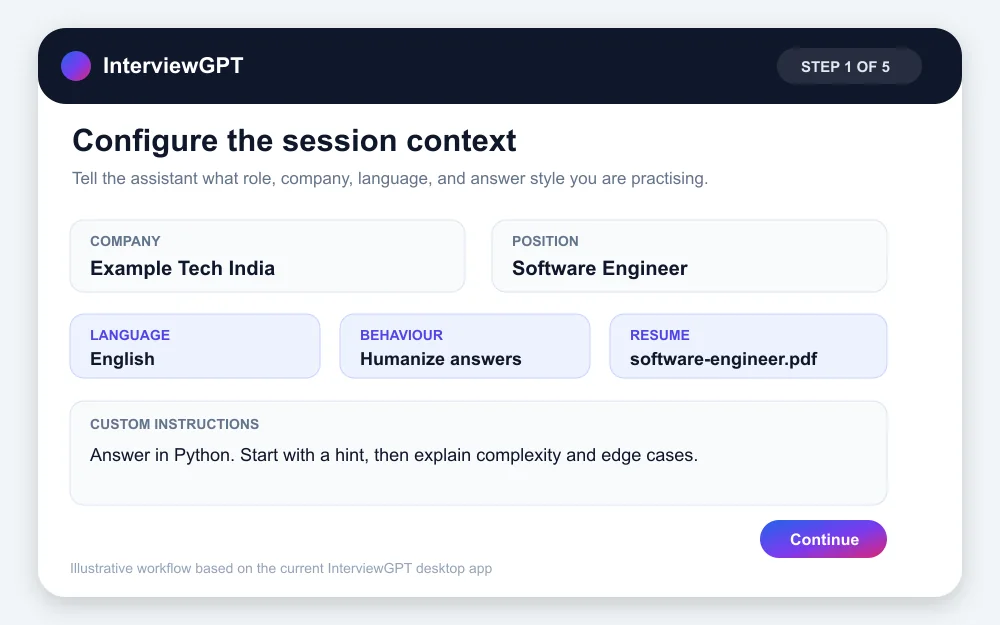
In InterviewGPT, create a session and configure:
- Target company and position
- Preferred programming language
- Resume and relevant project context
- AI model and response style
- Custom instructions such as "Give one hint at a time" or "Ask me to state complexity before showing improvements"
Use mock sessions to practise under realistic conditions. Speak aloud, share only the screen you would use in an interview, and avoid pausing the timer whenever you become uncomfortable. The goal is to improve performance under constraints.
During a Permitted Practice or Assisted Session
Step 1: Configure the SessionChoose the correct session type, role, language, resume, and instructions before the call begins. Good context produces more relevant guidance and reduces generic answers. For a backend role, for example, ask the assistant to prioritise APIs, databases, concurrency, and reliability.
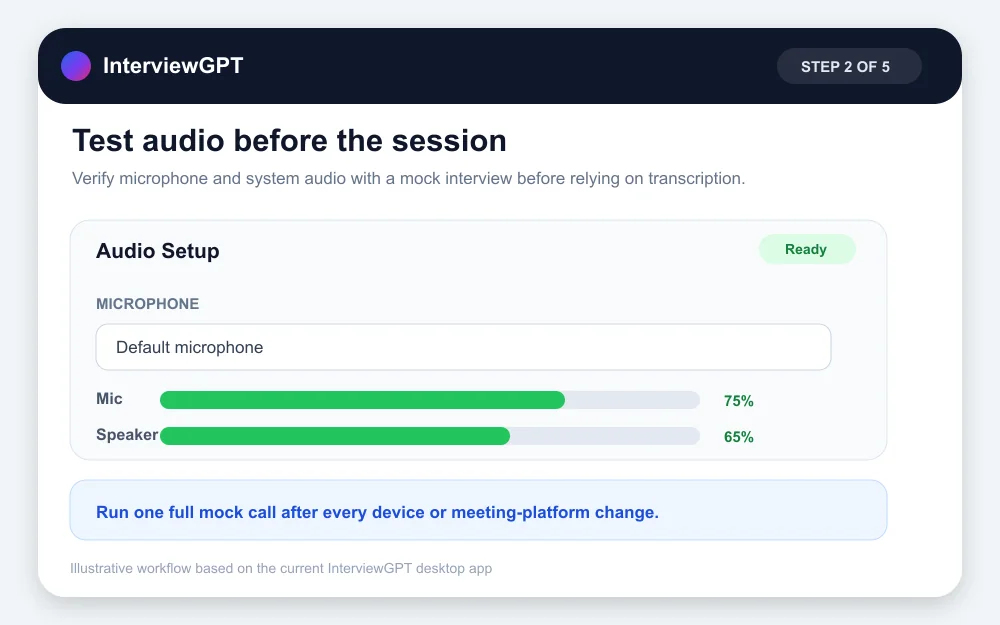
Step 2: Test Audio and Screen AccessTest microphone and system audio before entering the meeting. Confirm that the transcript captures both sides clearly and that your coding environment is readable. This prevents technical setup from consuming the first few minutes of a practice session or permitted interview.
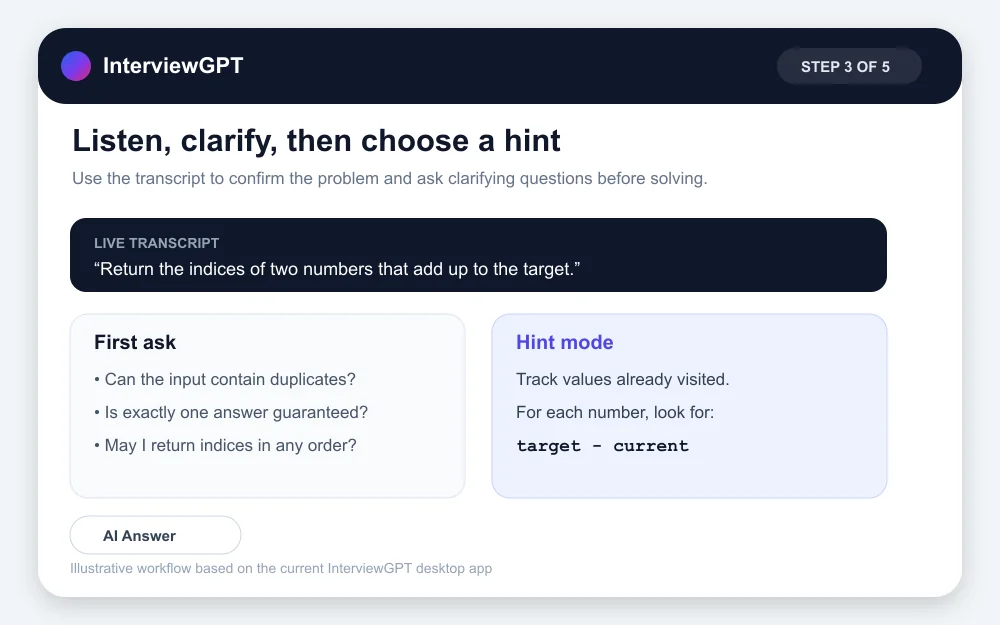
When stuck, request the smallest useful intervention. A good sequence is:
- Ask for a clarifying question you may have missed.
- Ask which data-structure family could help.
- Ask for one edge case.
- Ask for pseudocode only after attempting the approach.
- View a fuller explanation only during review.
This preserves productive struggle, which is where learning happens.
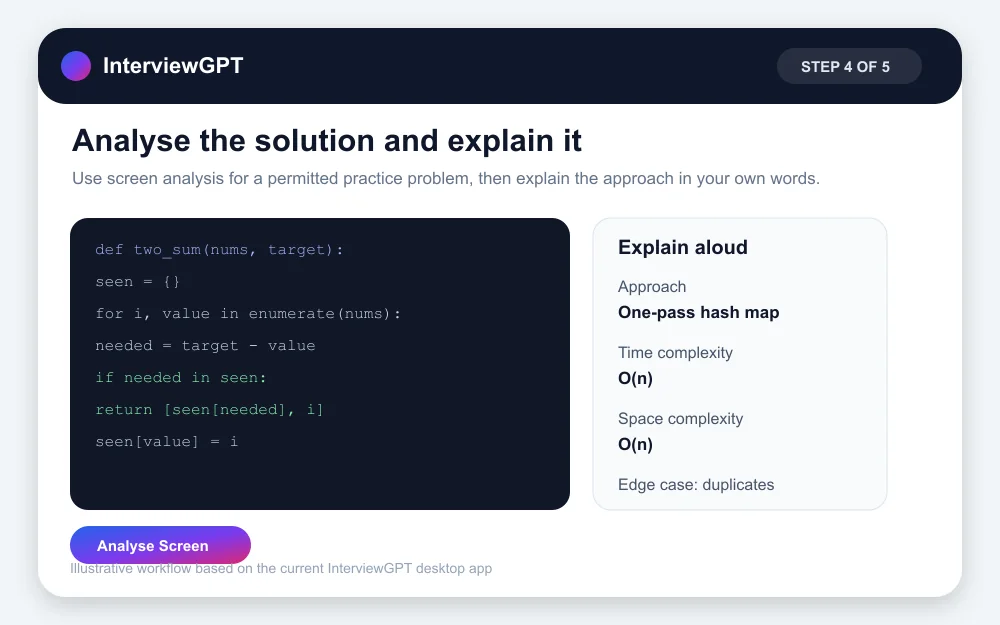
Use the AI answer or screen-analysis feature as a second opinion. Compare its approach with yours, then explain why one is better for the stated constraints. Always state time and space complexity and test normal, boundary, and invalid-input cases.
Do not read generated text word for word. Pause, organise the idea, and explain it naturally. If you cannot defend a suggestion, say what you know, test the uncertain part, or choose a simpler approach. Honest reasoning is stronger than confidently presenting code you do not understand.
After the Interview
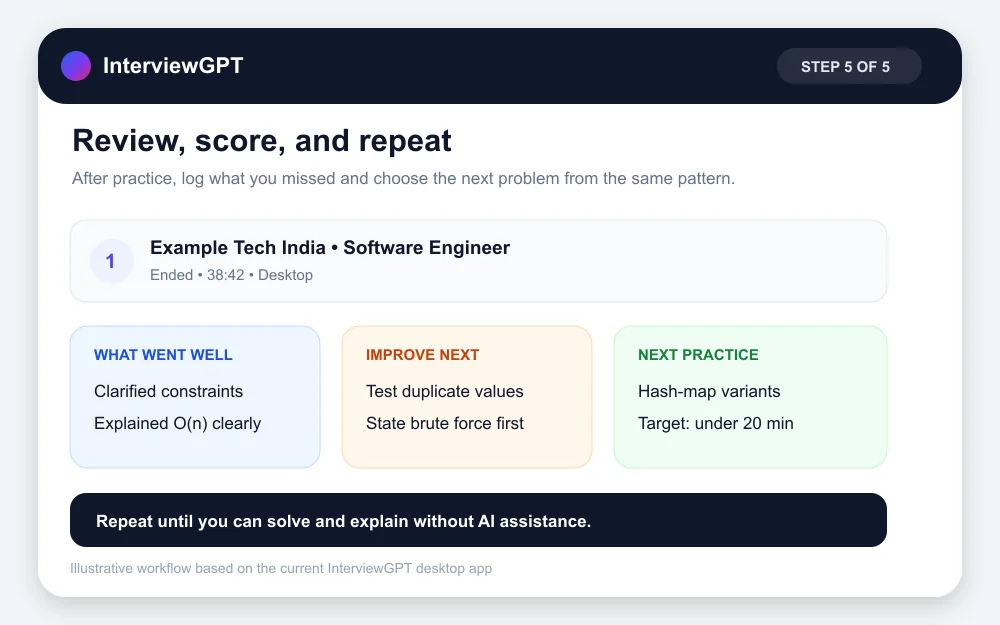
Review the transcript soon after every session. Mark where you misunderstood constraints, chose the wrong pattern, stopped explaining, introduced a bug, or missed an edge case. Turn each weakness into a small action for the next session.
Then re-solve the problem without AI. If you still need help, reduce it gradually: full explanation, then pseudocode, then one hint, then no hint. This creates measurable independence rather than tool dependency.
Download the coding interview AI preparation checklist and use it before every mock or permitted assisted session.
Top 10 InterviewGPT Features for Coding Interviews
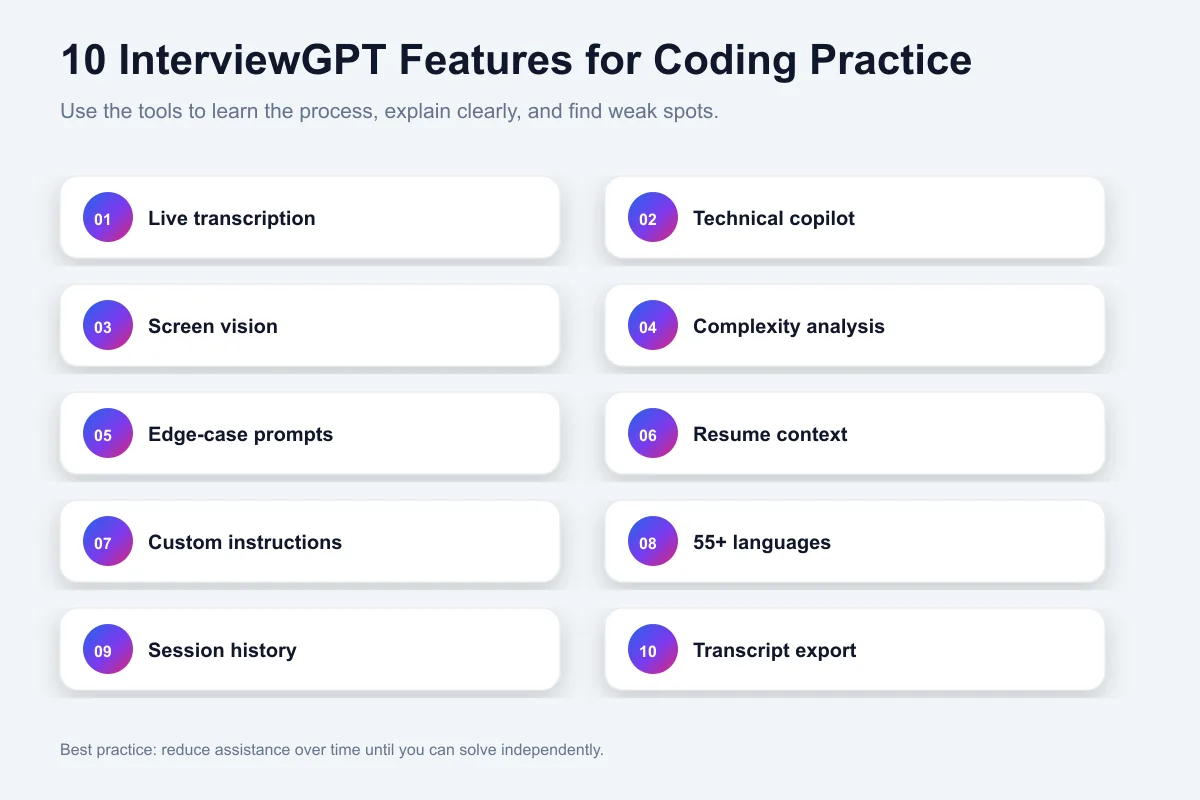
- Live transcription: Keeps the question visible so you can verify constraints and avoid solving the wrong problem.
- AI answer guidance: Provides concise suggestions when you need a hint, explanation, or alternative approach.
- Screen analysis: Helps interpret visible coding questions, diagrams, output, and error messages.
- Technical copilot: Supports DSA, system design, complexity analysis, and edge-case thinking.
- Company and role context: Tailors guidance to the position rather than producing a generic tutorial.
- Resume context: Connects project and behavioural answers to experience you can genuinely discuss.
- Custom instructions: Lets you request Socratic hints, preferred answer length, or a specific interview style.
- Programming-language selection: Keeps examples aligned with the language you intend to use.
- Session history: Makes it easier to review repeated weaknesses across practice sessions.
- Desktop workflow: Supports major meeting and coding environments that play through system audio.
Explore the current InterviewGPT features before practising, because product capabilities can change as the app improves.
Want to test the workflow? Start your free InterviewGPT practice session and ask for one hint at a time.
Common Coding Interview Questions and How InterviewGPT Helps
The best use of AI for programming interviews is learning repeatable reasoning, not memorising isolated answers.
Example 1: Two Sum
Problem: Return the indices of two numbers that add to a target.
A weak response jumps directly into code. A stronger response clarifies whether exactly one solution exists, explains the brute-force O(n²) approach, then improves it using a hash map:
def two_sum(nums, target):
    seen = {}
    for index, number in enumerate(nums):
        complement = target - number
        if complement in seen:
            return [seen[complement], index]
        seen[number] = index
    return []
The improved solution is O(n) time and O(n) space. InterviewGPT can prompt you to explain why you check before inserting and ask how duplicates affect the result.
Example 2: Valid Anagram
Problem: Determine whether two strings contain the same characters with the same frequencies.
from collections import Counter

def is_anagram(first, second):
    return Counter(first) == Counter(second)
This is O(n) time for equal-length strings and uses space proportional to the character set. During practice, ask the assistant for follow-ups: What if comparison must ignore spaces and case? What if memory is tightly constrained? Those questions turn a basic solution into an interview-quality discussion.
Example 3: Coin Change
For minimum coin change, first explain why a greedy choice does not work for every coin system. Then define dp[amount] as the minimum coins needed for that amount and build upward from zero. InterviewGPT can help identify the recurrence, but you should write and test it independently.
Useful edge cases include an amount of zero, no possible combination, duplicate coin values, and a coin larger than the target. Your final explanation should cover the O(amount × number_of_coins) time complexity.
System Design Practice
For a URL shortener or notification service, ask AI to act as the interviewer rather than provide a complete design. It should ask about scale, latency, data retention, APIs, storage, caching, failure modes, and trade-offs. You then lead the design and use screen analysis only to review your diagram or notes.
Pro Tips for Maximum Success
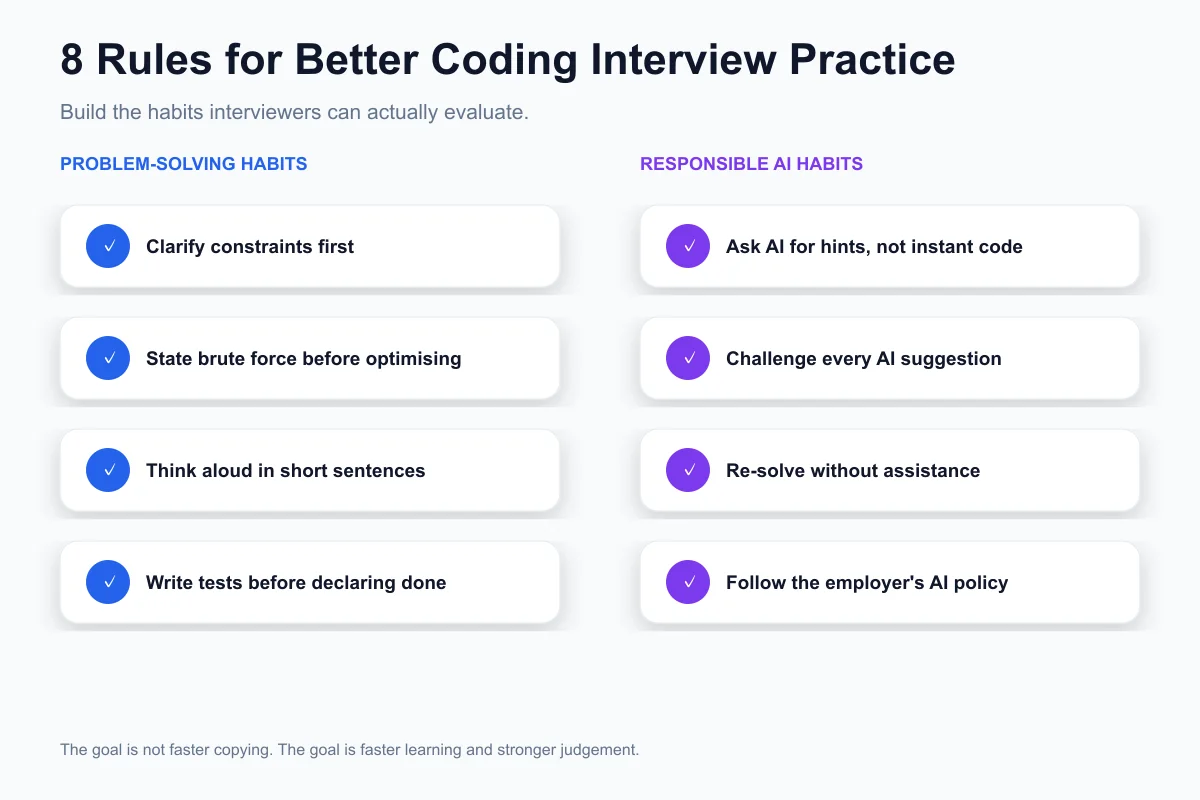
- Practise explaining before coding. State assumptions, constraints, and a simple approach first.
- Use a hint ladder. Ask for progressively stronger help instead of revealing the answer immediately.
- Track patterns, not question counts. Ten carefully reviewed problems can teach more than fifty rushed ones.
- Time-box being stuck. After five focused minutes, ask for a small hint and record what you missed.
- Test aloud. Walk through at least one normal case and two edge cases.
- Review complexity every time. Make time and space analysis automatic.
- Practise in your interview language. Avoid switching languages merely because an AI answer looks cleaner.
- Reduce assistance weekly. Your final mocks should resemble the actual interview rules.
- Prepare for follow-ups. Expect changes in constraints, scale, or required output.
- Check the company's policy. Never assume live AI assistance is permitted.
| Do | Don't |
|---|---|
| Use AI to diagnose weak concepts | Copy solutions without understanding them |
| Ask for one hint at a time | Read generated answers word for word |
| Verify code with tests and reasoning | Assume AI output is correct |
| Practise full sessions without assistance | Depend on AI during every problem |
| Follow interview and assessment rules | Hide prohibited tool use |
| Explain trade-offs in your own words | Optimise before understanding constraints |
Illustrative Practice Scenarios
The following are illustrative scenarios, not customer testimonials or verified outcome claims. They show how candidates can structure AI-assisted preparation.
Fresh Graduate Preparing for a Product Company
Ananya can solve easy array questions but freezes during medium problems. She configures InterviewGPT to provide one hint after five minutes and to ask for complexity before moving forward. After two weeks, her practice log shows fewer full-solution requests and clearer explanations. The useful metric is not an offer claim; it is her increasing ability to finish mocks independently.
Backend Engineer Revising System Design
Rohan has production experience but has not interviewed recently. He asks the AI to behave like a senior system-design interviewer and challenge his assumptions about scale, databases, caching, and failure recovery. He records the transcript, identifies repeated gaps in capacity estimation, and revisits those topics before the next mock.
Career Switcher Building Communication Skills
Meera understands programming fundamentals but gives unstructured answers. She uses transcript review to identify long pauses and missing clarifications. By practising concise problem restatements and test walkthroughs, she makes her reasoning easier to follow without changing the underlying solution.
InterviewGPT vs Traditional Interview Preparation
AI-assisted preparation does not replace books, courses, practice platforms, peers, or mentors. It adds fast, contextual feedback between those resources.
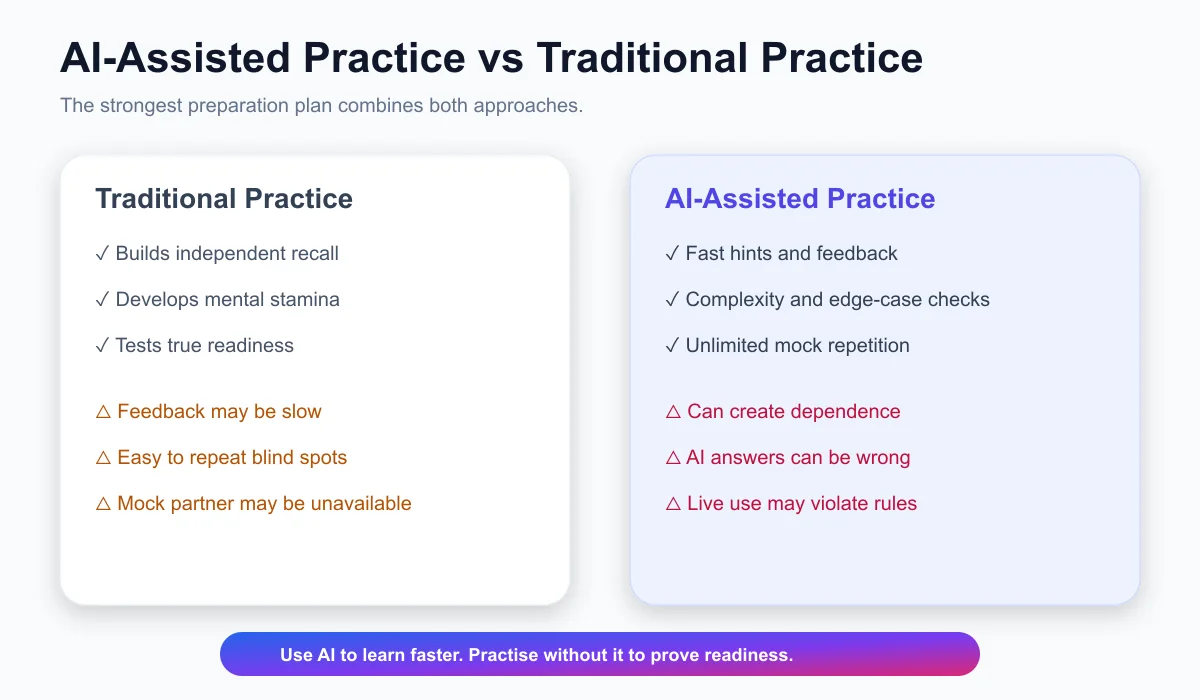
| Preparation factor | Traditional self-study | InterviewGPT-assisted practice |
|---|---|---|
| Feedback speed | Often delayed or unavailable | Immediate suggestions during practice |
| Personalisation | Depends on the resource | Can use role, company, resume, and instructions |
| Communication practice | Easy to skip when studying alone | Transcript makes spoken reasoning reviewable |
| Mock availability | Requires a partner or scheduled service | Available whenever you can practise |
| Weakness tracking | Manual notes | Session history and transcripts support review |
| Risk | Passive study and slow feedback | Over-reliance or incorrect AI suggestions |
| Best use | Building deep fundamentals | Applying fundamentals under interview conditions |
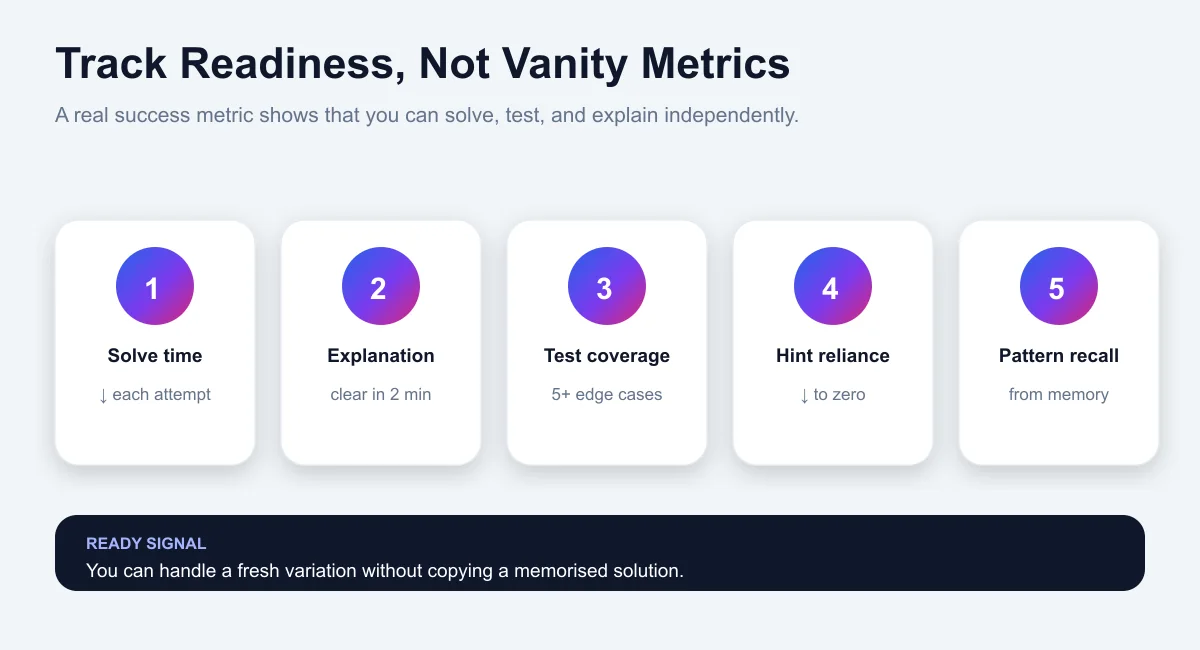
Track progress with concrete measures: percentage of problems solved without hints, average time to a correct approach, number of edge cases found, bugs caught before running code, and clarity of your explanation. These are more useful than an unverified "success rate."
Conclusion
Learning how to prepare for coding interview with AI is about creating a faster feedback loop while protecting independent thinking. Use InterviewGPT to simulate questions, request graduated hints, review transcripts, analyse visible problems, and practise explanations. Then remove the assistance and prove that you can solve and communicate on your own.
The strongest candidates combine fundamentals, deliberate practice, honest self-review, and responsible tool use. Confirm the employer's rules, verify every AI suggestion, and focus on reasoning you can defend.
Compare the wider market in InterviewGPT vs Other AI Interview Assistants, or review 10 reasons InterviewGPT works for Indian job seekers.
Try InterviewGPT today to begin a focused mock session, or review the latest plans and free-trial details.
Frequently Asked Questions
Can AI help me prepare for a coding interview?
Yes. AI can simulate interview questions, provide hints, explain patterns, generate edge cases, review communication, and help organise a study plan. You should still complete regular practice without AI assistance.
Is AI allowed during a real coding interview?
Only when the employer explicitly permits it. Policies vary by company and assessment. Ask before the interview, follow written rules, and disclose assistance when required.
Does InterviewGPT support coding interview questions?
InterviewGPT supports technical workflows including data structures and algorithms, system design, complexity analysis, edge cases, live transcription, AI answers, and screen analysis.
Which programming languages and meeting platforms does InterviewGPT support?
InterviewGPT lets candidates select a programming language and works with major meeting or coding platforms that play through system audio. Check the latest product features and test your exact setup before an important session.
How do I avoid becoming dependent on AI?
Use a hint ladder, retry every missed problem without help, and schedule full mocks with no assistance. Track how often you need hints and reduce that number over time.
Is InterviewGPT available for Indian job seekers?
Yes. InterviewGPT is designed for Indian candidates, supports Windows and macOS, lists plans in Indian rupees, and offers a free trial. Check the pricing section for current details.