

Resume-Aware AI Interview Assistants: Better Personalized Answers
Learn how resume, target-role and custom-instruction context improves AI interview answers, plus a safe setup template for InterviewGPT.
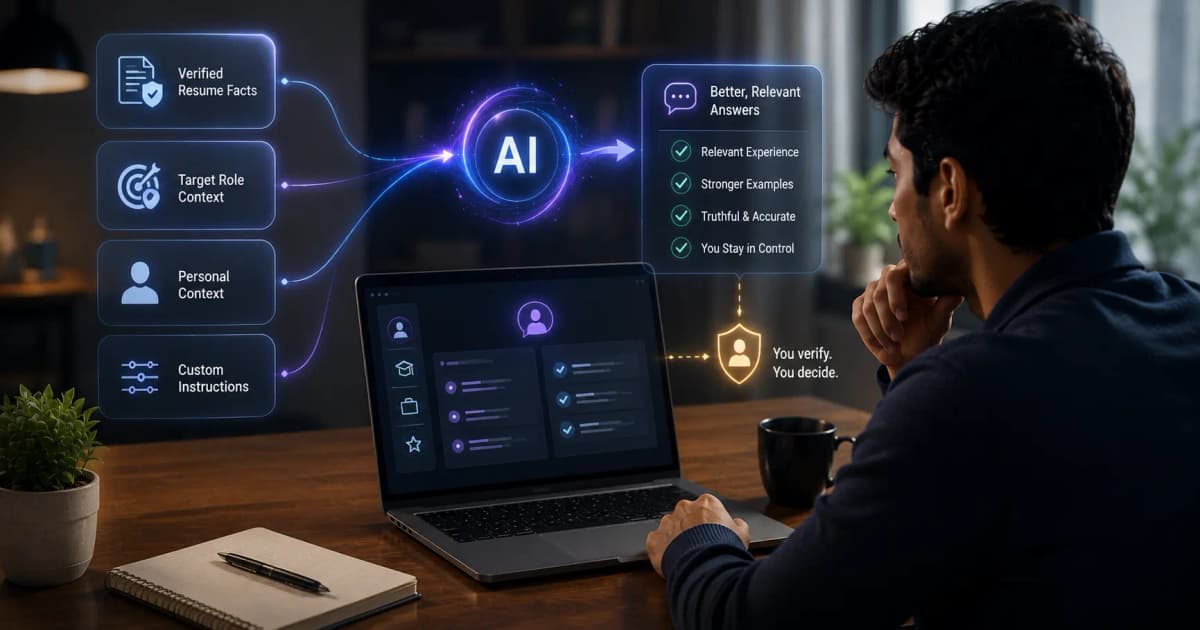
A resume-aware AI interview assistant uses your verified career history, target role, and answer preferences to generate more relevant talking points. The improvement is not magic: better context reduces generic output, but the candidate must keep every project, skill, result, and metric truthful.
InterviewGPT supports resume selection, company and position fields, language choice, and custom user instructions when starting a session.
Why generic answers fail
A generic response to “Tell me about a difficult project” might mention collaboration, deadlines, and problem-solving without naming a real situation. That sounds polished but interchangeable.
A grounded response can remind you of:
- the actual project and business goal;
- your specific responsibility;
- the constraint you faced;
- the decision you made;
- a verified result;
- what you learned.
The AI should help retrieve and structure your evidence, not manufacture it.
The four layers of useful context
1. Resume facts
Use the latest version sent to the employer. Remove outdated drafts and check dates, titles, technologies, and metrics. If a metric is confidential or uncertain, replace it with a truthful qualitative outcome.
2. Target role
The same project should be framed differently for a backend engineer, product manager, or data analyst. Enter the exact role and, when appropriate, the company so suggestions emphasize relevant trade-offs.
3. Job-description priorities
Extract five capabilities the employer repeatedly mentions. Do not paste confidential recruiter notes. Use public job-description language to help select the best real examples.
4. Custom instructions
Instructions control form, not facts. Good instructions include:
Use concise first-person talking points. Prefer examples from my resume. Do not invent metrics, employers, tools, or responsibilities. Use STAR for behavioral questions and explain assumptions before code for technical questions.
A context-preparation worksheet
Create this table before uploading anything:
| Interview theme | Verified example | Evidence | Risk to avoid |
|---|---|---|---|
| Leadership | Project or incident | Team size, decision, result | Claiming authority you did not have |
| Conflict | Real disagreement | Your action and resolution | Blaming another person |
| Failure | Genuine setback | Learning and changed behavior | Fake weakness |
| Technical depth | System or feature | Constraints and trade-offs | Listing tools you cannot explain |
| Impact | Delivered outcome | Approved metric or observable result | Invented percentage |
This worksheet is more valuable than adding a very long raw document.
How to configure InterviewGPT
- Upload or select the resume used for the application.
- Enter the target company and position accurately.
- Choose the transcription language used in the call.
- Add brief custom instructions.
- Decide whether automatic answer generation suits the practice scenario.
- Test three questions and inspect whether the suggestions cite real experience.
If an answer introduces a false claim, correct the context or ignore the suggestion. Never repeat it because it sounds confident.
Test personalization with an A/B method
Ask the same question twice in a private practice session:
- Test A: minimal context—only the role.
- Test B: resume, role, one verified project, and answer instructions.
Score each response from 1 to 5 for relevance, factual accuracy, specificity, natural tone, and ease of speaking. Keep the context only if it improves the total without adding false details.
Protect personal and confidential information
Resumes contain personal data. Upload only what is required, review the current privacy policy, and delete obsolete documents. Do not include passwords, government identifiers, health details, client secrets, proprietary source code, or information you are not allowed to share.
Session transcripts may also contain personal or company information. Export and store them carefully, and obtain consent where recording or retention rules require it.
Make answers sound like you
Personalization should preserve your speaking style. Use short instructions such as:
- “Give a 45-second answer first.”
- “Use simple Indian English without slang.”
- “Offer three talking points, not a script.”
- “Ask me to clarify if the resume lacks evidence.”
- “For coding, explain complexity and edge cases.”
Practice paraphrasing. Reading a generated paragraph word for word usually sounds less natural than using it as a compact reminder.
Where InterviewGPT fits
InterviewGPT combines personalized context with live transcription, AI suggestions, Screen Vision, technical support, and session history in its Windows workflow. The resume-aware feature is useful only when the source context is accurate. It cannot verify every career claim automatically.
For a broader overview, read the InterviewGPT feature guide and the natural-answer customization guide.
Bottom line
The best resume-aware assistant is not the one that writes the longest answer. It is the one that helps you recall the right truthful evidence quickly and express it clearly. Build a small, verified context pack, test it against real questions, and remain the final editor of every suggestion.
Download InterviewGPT and begin with a private practice session before using personalized context in a live interview.
Sources
InterviewGPT context fields were verified against the current Windows session configuration and official feature page on July 19, 2026. Data-handling guidance should be read with the current privacy policy.