
AI Interview Assistant for Career Switchers: Translate Experience into Evidence
Use an AI interview assistant to map transferable skills, explain a career change, build credible project evidence, and prepare role-specific answers.

An AI interview assistant for career switchers should help translate experience without pretending the old and new roles are identical. The candidate needs a clear reason for the move, evidence of transferable skills, proof of new capability, and realistic expectations about the first step.
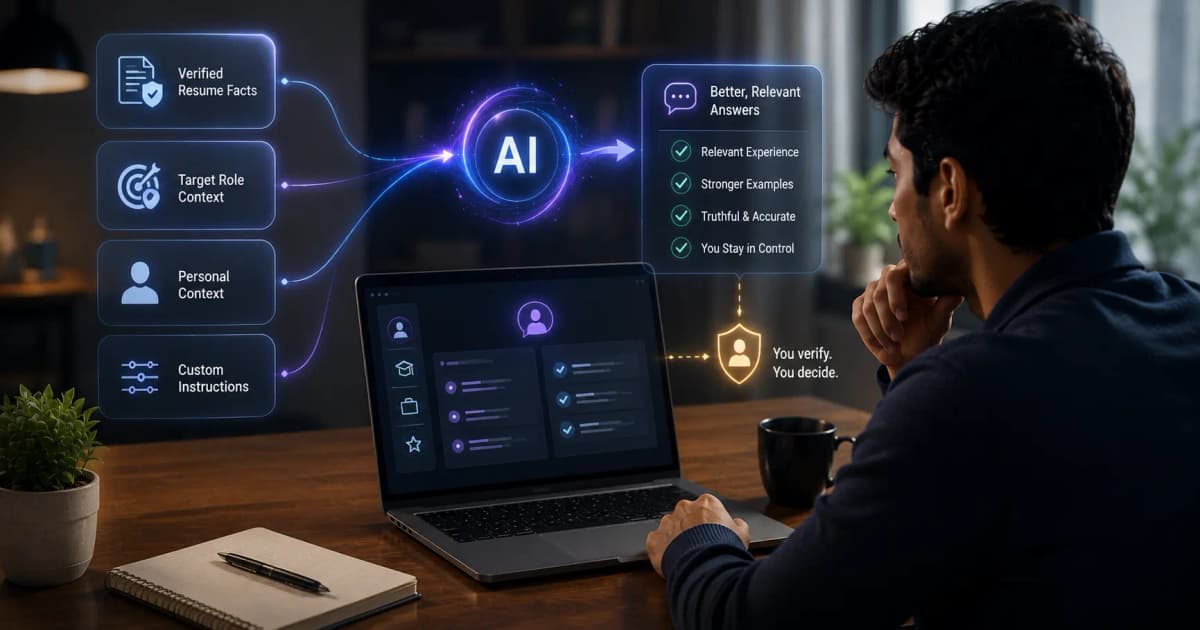
InterviewGPT can combine a submitted resume, target-role context, custom instructions, transcription, and session review to make that story consistent.
Build a transfer map
Create four columns:
| Previous evidence | Transferable capability | Target responsibility | Proof gap |
|---|---|---|---|
| Managed weekly operations report | Data validation and stakeholder communication | Analyst reporting | Need stronger SQL project |
| Coordinated feature launch | Prioritization and cross-functional work | Product execution | Need product metrics example |
This prevents two extremes: dismissing past experience or claiming direct experience you do not have.
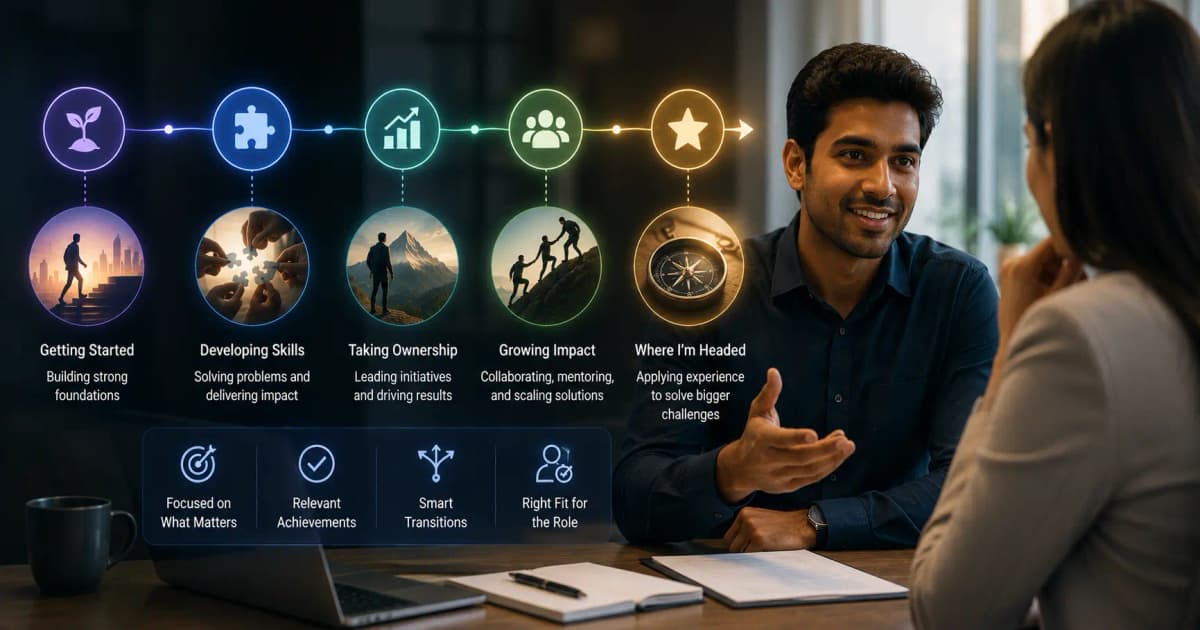
Use the BRIDGE story
- B — Background: Summarize the previous field.
- R — Reason: Explain the informed motivation for changing.
- I — Investment: Show learning or practical work completed.
- D — Demonstration: Give evidence from a project or transferable achievement.
- G — Gap: Acknowledge what you still need to learn.
- E — Entry value: Explain what you can contribute now.
The Gap step builds credibility. Career switching does not require pretending to be fully experienced on day one.
Example: operations to data analytics
I spent four years in operations, where I regularly investigated delays and presented weekly performance reports. I became interested in the analysis behind those decisions, so I strengthened SQL and dashboard skills and built two projects using operational datasets. I am moving into analytics because it combines the domain judgment I already have with the technical work I want to deepen. I will still need to learn your data model, but I can contribute strong problem definition and stakeholder communication from the start.
Example: support to product management
Customer support gave me direct exposure to recurring user problems and the cost of unclear product decisions. I began partnering on issue prioritization, completed product case projects, and learned basic metrics and experimentation. I am now targeting an associate product role where I can bring customer evidence and execution discipline while developing broader roadmap judgment.
Create new evidence
Courses alone rarely answer “Can you do the work?” Build one or two realistic projects, document decisions, ask for review, and be ready to discuss trade-offs and limitations. Do not copy a tutorial and present it as independent work.
Configure InterviewGPT for honest translation
Use this instruction:
Map my verified previous experience to the target job requirements. Label direct experience, transferable experience, and gaps separately. Build short talking points and never rewrite a transferable skill as years of direct role experience.
Pair this with the resume-aware guide and employment-gap guide when relevant.
Prepare the questions career switchers receive
- Why change now?
- What have you done to test the new path?
- Which skills transfer directly?
- Where will you need support?
- Are you comfortable with a different level or compensation structure?
- Why should we choose you over someone with direct experience?
Answer without criticizing the old career. Show that the move is informed rather than impulsive.
A two-week rehearsal plan
Week one: map requirements, verify stories, complete or improve one proof project, and practice technical basics. Week two: rehearse the BRIDGE narrative, role scenarios, behavioral stories, and questions for the hiring manager. Review transcripts for inflated claims and unexplained jargon.
Common mistakes
- Calling the previous career wasted time
- Listing courses without demonstration
- Hiding genuine skill gaps
- Applying one generic story to unrelated roles
- Claiming seniority in the new function too early
- Allowing AI to invent a smoother timeline
Where InterviewGPT fits
InterviewGPT supports resume and target-role context, custom natural-answer instructions, live transcription, compact controls, history, and export on Windows. It can organize preparation, but the evidence must come from the candidate.
Bottom line
Career switchers win trust by translating real evidence, demonstrating new effort, and naming gaps without apology. Use AI to improve clarity, not to erase the transition.
Download InterviewGPT and build a truthful BRIDGE answer for your target role.
Sources
- InterviewGPT product information
- Verify role requirements from current employer job descriptions and official skills documentation.