
AI Interview Assistant for Software Engineers: Coding, System Design, and Behavioral Rounds
Learn how software engineers can use an AI interview assistant to prepare for coding, system design, project deep dives, and behavioral rounds.

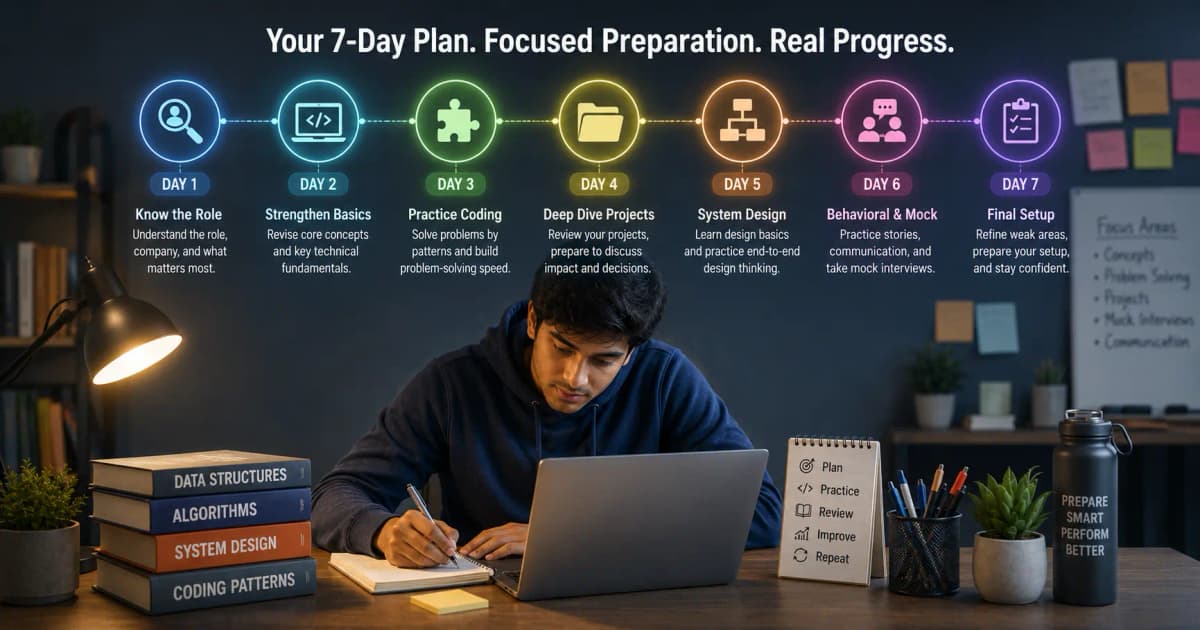
An AI interview assistant for software engineers should help with four different jobs: clarify the question, organize an approach, expose edge cases, and keep the candidate’s explanation grounded in real experience. It should not replace fundamentals or silently invent projects.
InterviewGPT combines live transcription, resume and role context, technical answer guidance, Screen Vision, custom instructions, and compact Windows controls. Use those capabilities only where the interviewer or assessment rules permit outside assistance.
What software engineering interviews actually test
Most engineering loops mix several formats:
| Round | What interviewers evaluate | Useful preparation output |
|---|---|---|
| Coding | Correctness, complexity, testing, communication | Restatement, approach, edge cases, test plan |
| System design | Requirements, trade-offs, scale, reliability | Structured design checklist and alternatives |
| Project deep dive | Ownership and technical judgment | Evidence from verified resume projects |
| Behavioral | Collaboration, conflict, learning | Short STAR outline with real details |
| Hiring manager | Scope, motivation, seniority | Role-specific talking points and questions |
Treating all five as “generate an answer” produces weak preparation. Each round needs its own response shape.
A coding-question workflow
Before writing code, state the input, output, constraints, and one example. Then work through this sequence:
- Describe a simple correct approach.
- Identify its time and space cost.
- Explain the optimization and why it is valid.
- Name edge cases before implementation.
- Test the finished code aloud.
Configure InterviewGPT to return prompts rather than a wall of code: “Give a one-sentence restatement, two approach options, complexity, and five edge cases. Do not invent constraints.” This keeps the candidate responsible for the implementation and explanation.
For a deeper workflow, use the explanation-first coding workflow.
A system-design workflow
System design rewards disciplined narrowing. Start with users, core actions, scale assumptions, consistency needs, and failure tolerance. Only then draw services and data flows.
A practical order is:
- functional and non-functional requirements;
- rough traffic and storage estimates;
- API and main data model;
- high-level components;
- one critical request path;
- bottlenecks, failures, and observability;
- trade-offs and next iteration.
If a diagram or prompt is visible on screen, Analyze Screen captures your screen and helps interpret it. Verify every captured detail and never assume the assistant has seen anything that was not on screen when you captured it.
Make project answers resume-safe
Upload only the resume version sent to the employer. Prepare a fact sheet for each major project: problem, your ownership, architecture, difficult decision, measurable result, and lesson. Tell the assistant to use only those facts.
A useful instruction is:
Build a 60-second project answer from verified resume context. Separate team outcomes from my contribution. If a metric is missing, insert a prompt to clarify instead of inventing one.
This prevents polished but unverifiable claims.
Prepare for behavioral engineering questions
Engineering behavioral rounds often focus on disagreement, incidents, missed estimates, mentoring, and ambiguous requirements. Prepare six adaptable stories rather than memorizing twenty scripts. Use the STAR method guide to keep the action and result specific.
Senior candidates should emphasize decisions, trade-offs, alignment, and consequences. Junior candidates can use internships, academic projects, open source, or substantial personal work, provided the ownership is clear.
A 45-minute rehearsal plan
Spend 15 minutes on a medium coding problem, 15 on one system component, and 15 on a project deep dive. Review the transcript afterward and mark:
- vague requirements you failed to clarify;
- unexplained complexity claims;
- missing failure scenarios;
- answers longer than two minutes;
- any statement not supported by your experience.
The transcript is most valuable as a review artifact, not a script to recite.
Common mistakes
- Reading generated code without understanding it
- Claiming a technology because it appears in the job description
- Jumping into architecture before agreeing on requirements
- Giving team achievements as personal achievements
- Ignoring the employer’s assessment policy
- Using long suggestions that interrupt eye contact and reasoning
Where InterviewGPT fits
InterviewGPT is a Windows-first assistant for behavioural and technical interviews. It can combine system-audio transcription, resume context, role instructions, technical guidance, Screen Vision, history, and export. The free Invisible Browser is a separate research workspace that never uses credits; live AI help uses the free 10-minute sessions, hour credits or an Unlimited pass.
Bottom line
The best AI interview assistant for a software engineer strengthens the reasoning loop: understand, plan, implement, test, and explain. Use it to prepare structure and review performance, never to substitute for knowledge or violate assessment rules.
Download InterviewGPT and run one permitted coding, design, and behavioral rehearsal before your next engineering loop.