
Multilingual AI Interview Assistant: How to Prepare Across Languages
Prepare multilingual interviews with language testing, technical-term glossaries, bilingual answer plans, audio checks, and honest proficiency boundaries.

A multilingual AI interview assistant can help preserve questions, organize bilingual talking points, and reduce translation friction, but language support must be tested with the exact accent, terminology, and audio setup. Never claim professional fluency that you do not have.
InterviewGPT lets candidates configure transcription and answer context for supported workflows. Available languages and quality can change by provider and model, so verify the current production settings before publishing or relying on a specific language.
Clarify the interview language first
Ask the recruiter which parts of the process use which language. A role may conduct HR discussion in one language, technical terms in English, and customer scenarios in another. Confirm whether switching languages is acceptable.
Do not assume the interviewer wants translation merely because both speakers share another language.
Build a bilingual glossary
Prepare 20 to 40 terms specific to the role:
- product and domain vocabulary;
- technical acronyms;
- job titles and team names;
- metrics and units;
- words that speech recognition often confuses;
- company or product names.
For each, record the preferred spoken form and a short definition. Keep English technical terms in English when that is the normal professional usage.
Choose an answer-language policy
Define one of three modes:
- Answer in the interviewer’s current language.
- Keep the main answer in the agreed language but retain technical terms in English.
- Ask permission to clarify a difficult term in another language, then return.
Consistency is easier to follow than uncontrolled switching.
Test transcription with realistic audio
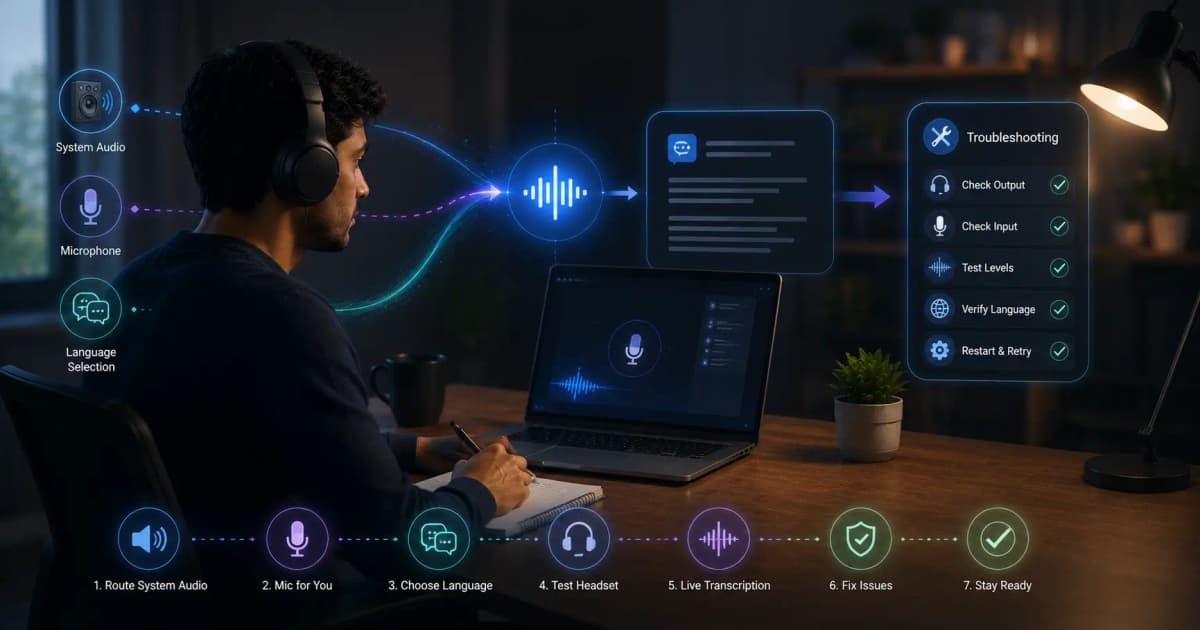
Run a private test using the same microphone, room, Windows device, and meeting platform. Include names, numbers, acronyms, and code-switching. Measure practical accuracy by whether the transcript preserves meaning—not by whether punctuation is perfect.
If remote audio is missing, fix the input path using the live transcription guide.
Configure concise bilingual guidance
A useful instruction is:
Answer in [chosen language] while keeping standard technical terms in English. Use short sentences and three talking points. Do not translate company names, code, or acronyms. If the transcript is ambiguous, ask me to clarify instead of guessing.
For Hindi and English switching, see the dedicated Hindi and Hinglish guide.
Avoid false fluency
An assistant may produce advanced vocabulary that does not match your speaking level. Simplify wording so you can explain follow-up questions naturally. If the role requires professional proficiency, represent your level honestly on the resume and in the interview.
Translation also changes nuance. Review sensitive examples about conflict, negotiation, and leadership with a fluent speaker when possible.
Privacy across languages
Transcripts can contain personal and employer information regardless of language. Store only necessary context, review the privacy policy, and follow consent and retention rules. Do not assume a less common language makes the data anonymous.
Common mistakes
- Enabling a language without an end-to-end audio test
- Translating standard technical terms unnaturally
- Switching languages in every sentence
- Using vocabulary you cannot explain
- Guessing when speech recognition is ambiguous
- Claiming that one test proves universal accent accuracy
Where InterviewGPT fits
InterviewGPT combines Windows transcription, context-aware answer guidance, custom instructions, compact controls, session history, and export. Language availability and quality depend on the active production configuration, so check the app and run a realistic test. The free Invisible Browser never uses credits.
Bottom line
Prepare the language plan the same way you prepare content: clarify expectations, build a glossary, test real audio, and use words you genuinely own.
Download InterviewGPT and run a permitted multilingual rehearsal before the live call.