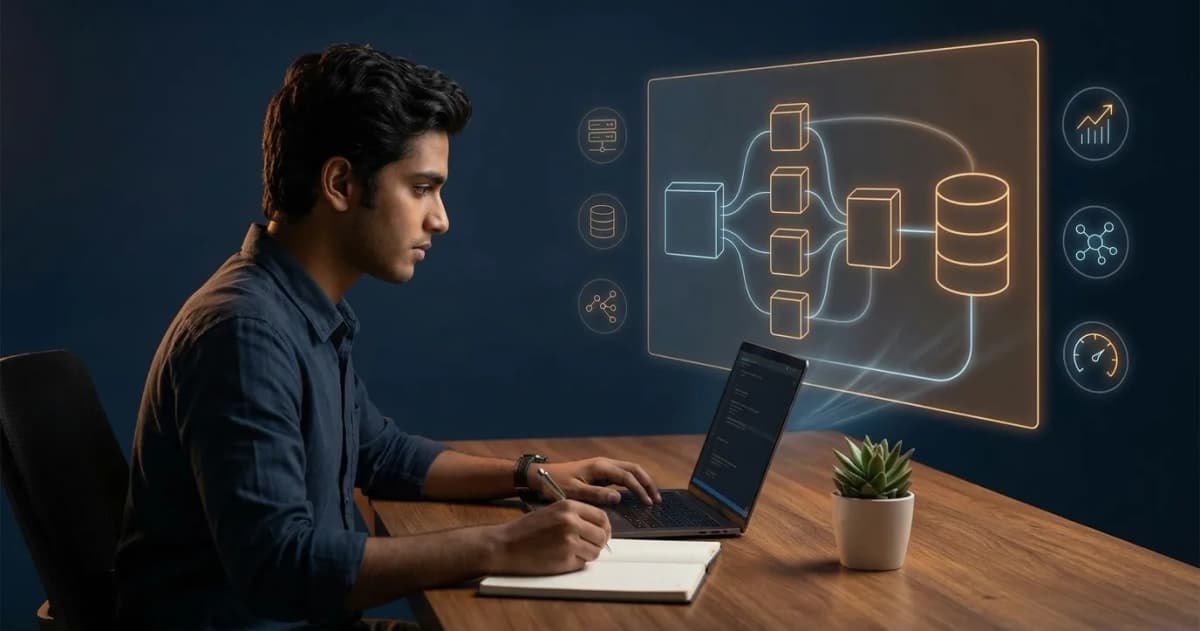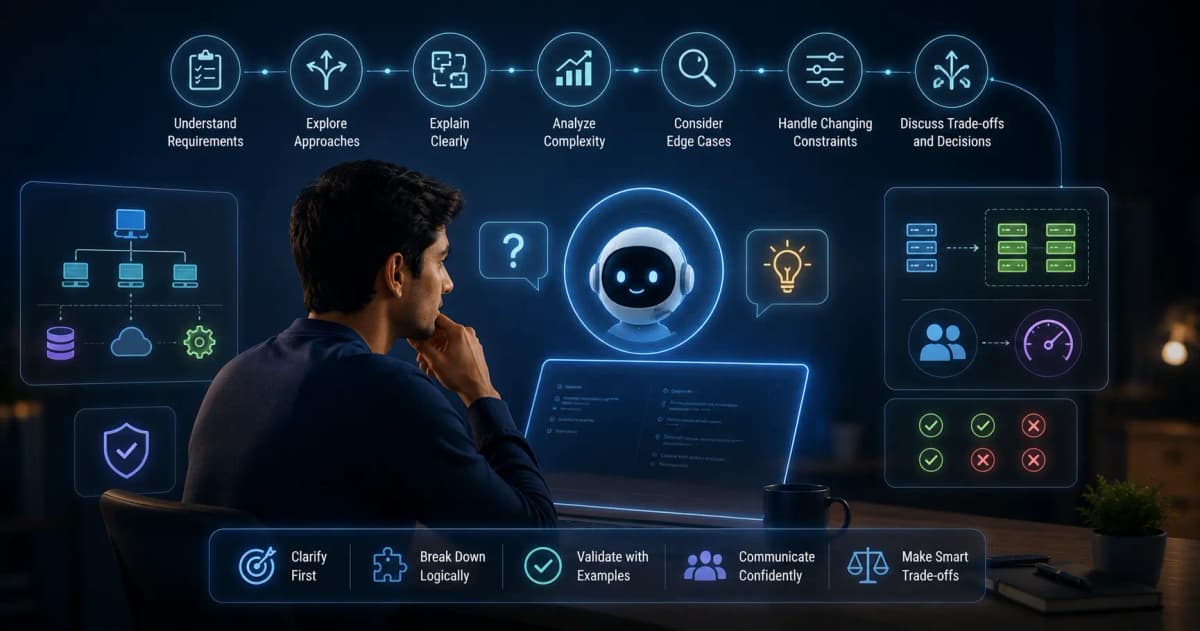

How to Prepare for a Technical Interview in 7 Days
A realistic seven-day technical interview plan covering role research, DSA, project depth, system design, mocks, communication and setup.
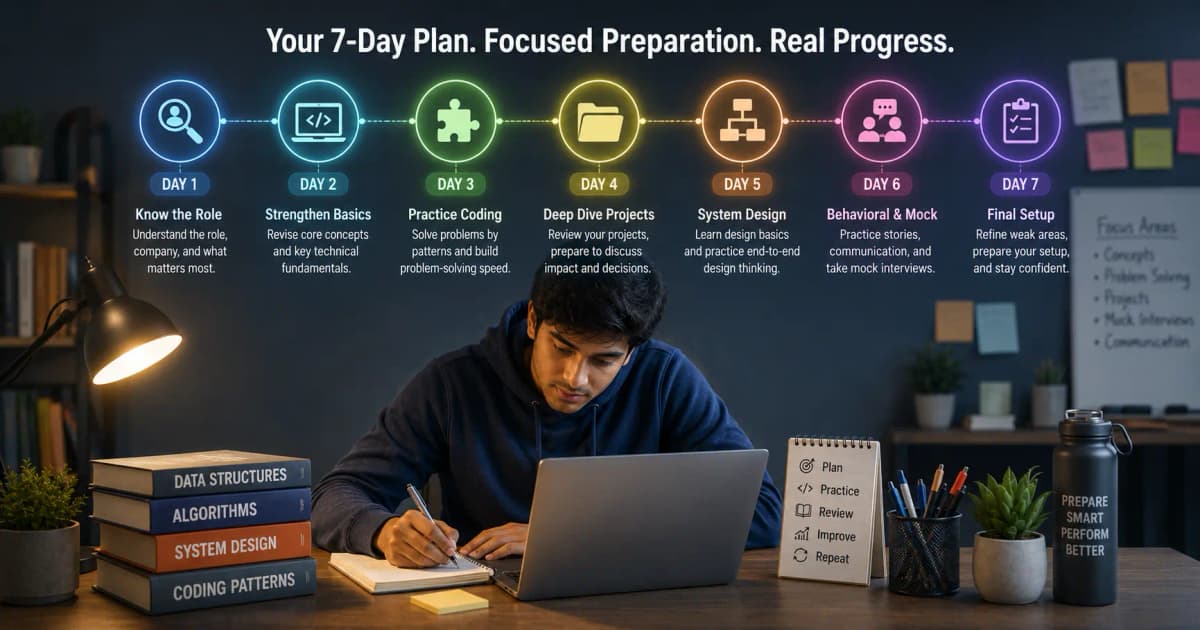
Seven days is enough to improve interview performance, but not to master an entire computer-science curriculum. Prioritize the actual role, your weakest high-probability area, your own projects, and communication. Avoid random problem volume and late-night cramming.
Day 1: reverse-engineer the interview
Read the job description and recruiter emails. Identify likely rounds, programming language, coding platform, system-design level, and behavioral themes. Build a matrix of required skills, your evidence, and gaps. Ask the recruiter for format clarification when appropriate.
Choose one language and environment. Do not switch unless required.
Day 2: high-frequency DSA patterns
Review arrays/strings, hash maps, two pointers, sliding window, stack/queue, binary search, trees, graphs, and basic dynamic programming according to the role. Solve fewer problems deeply:
- Explain brute force.
- Derive the optimization.
- State complexity.
- Test edge cases.
- Re-solve without notes.
Day 3: project and fundamentals deep dive
For two resume projects, prepare architecture, your ownership, hardest bug, trade-off, testing, deployment, metrics, and what you would change. Review fundamentals relevant to the job: OOP, databases, networking, operating systems, APIs, concurrency, cloud, or frontend behavior.
Day 4: system design at the right level
Practice this flow:
requirements → estimates → APIs/data → high-level design → deep dive → failure/scaling → trade-offs
For entry-level roles, focus on clear components and data flow. For experienced roles, add capacity, consistency, partitioning, caching, queues, observability, security, and failure recovery. State assumptions instead of pretending estimates are exact.
Day 5: behavioral and communication
Prepare five real STAR stories: impact, conflict, failure, ambiguity, and leadership. Practice “Tell me about yourself,” project walkthrough, and why this role. Record yourself explaining a solution aloud; remove filler and make decisions explicit.
Day 6: two realistic mocks
Run one coding mock and one mixed technical/behavioral mock under time pressure. Use the real editor, headset, video platform, and screen-share mode. Review errors by category: knowledge, approach, implementation, testing, communication, or setup.
An AI assistant can generate follow-ups and structure feedback, but it should not hide knowledge gaps. If using InterviewGPT, test coding/screen context in the mock and verify every suggested step.
Day 7: consolidate and recover
Re-solve two representative problems, review project/system-design one-pagers, confirm logistics, and stop heavy study early. Test internet, power, camera, audio, screen sharing, links, and a backup device. Sleep is more valuable than one unfamiliar hard problem.
Daily schedule
Use 2–4 focused hours: 90 minutes core practice, 45 minutes explanation/review, 30 minutes project or behavioral work, and 15 minutes error-log updates. Adjust for your baseline; avoid burnout.
AI-assisted preparation without dependency
Use AI to create role-specific questions, challenge assumptions, review explanation clarity, and simulate follow-ups. Ask it to withhold answers until you commit to an approach. During any live session, follow the interview's rules and maintain a no-tool framework.
Read the coding and system-design assistant guide, Windows setup checklist, or download InterviewGPT for a permitted dry run.