

Should You Put a Photo on Your Resume in India? (2026 Guide)
Most Indian resumes don't need a photo. See when to add one, how it affects ATS, Naukri's photo rules and which personal details to drop.
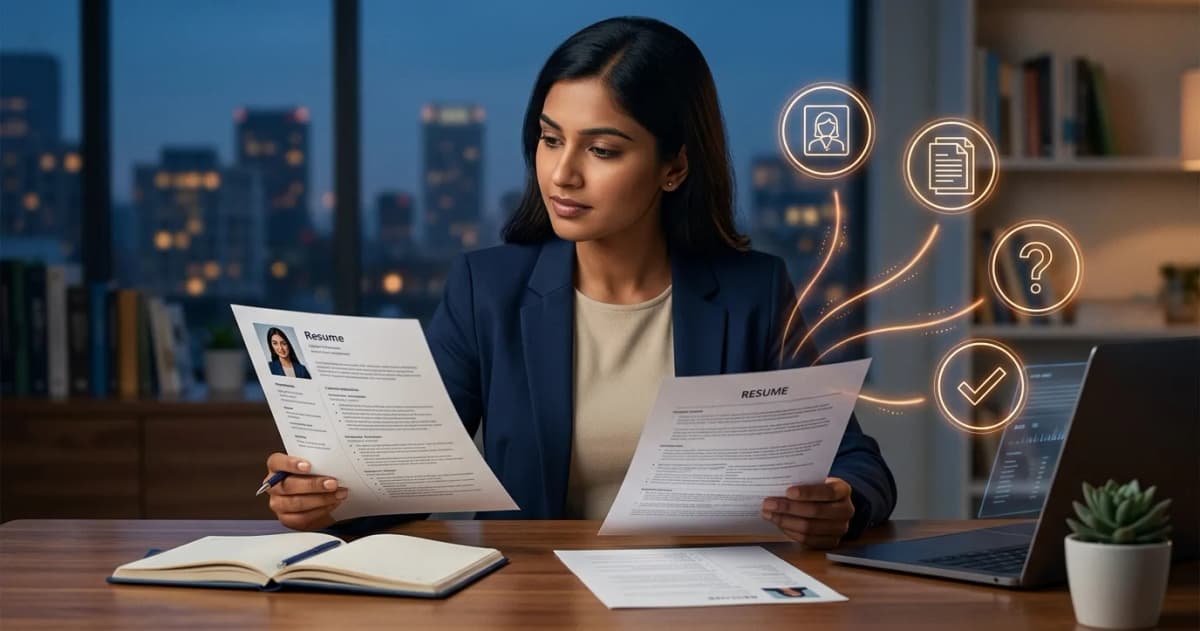
For most jobs in India, leave the photo off your resume. IT, engineering, finance, consulting and MNC applications don't need one, and a photo adds nothing to an applicant tracking system. Add a photo only when the employer or job post asks for it, or for roles where appearance is part of the job, such as front office, hospitality, aviation or modelling. Your LinkedIn and Naukri profiles are where your photo belongs.
That is the short answer. Below is a situation-by-situation table, how a photo affects ATS parsing, what to do if you include one, and the other personal details Indian resumes often carry that you can drop. If you want both versions ready, the AI resume builder has ATS-friendly templates with and without a photo, so you can switch in one click.
When to add a photo and when to skip it
| Situation | Photo? | Why |
|---|---|---|
| IT and software jobs (TCS, Infosys, product companies, startups) | Skip | Recruiters screen on skills and projects; most applications go through an ATS or portal |
| Campus placement drives | Skip, unless the placement cell's format includes one | Follow your college's template if there is one; otherwise one clean page without a photo |
| Finance, consulting, MNC corporate roles | Skip | Global firms often follow US and UK conventions, where photos are not expected |
| Applying to companies in the US | Skip | Harvard's career guide lists "Include a picture" under things not to do |
| Front office, hospitality, aviation, retail floor, modelling, acting | Add, if the job post asks or it is the norm in that field | Presentation is part of the job |
| The job post or HR explicitly asks for a photo | Add | Follow the instruction; missing items can stop an application |
| Government jobs and exams | Upload it where the form asks | Official forms have their own photo upload with fixed specs; follow those, not your resume |
| Naukri, LinkedIn and other profiles | Add on the profile | Recruiters see your profile photo there, so your resume doesn't need one |
Why most Indian resumes don't need a photo
A resume has one job: get a recruiter to call you for an interview. The person screening it is looking for the role you want, your skills, your projects or experience and your education. A photo answers none of those questions, and it takes space you could use for a project bullet. Harvard's career services guide puts "Include a picture" and "Include age or gender" on its list of things not to do.
There is also a fairness side. When your photo, age, religion or marital status sit at the top of the page, they invite judgements that have nothing to do with the work. Leaving them out keeps attention on what you can do.
Many freshers worry that a resume without a photo looks incomplete. When the job post didn't ask for one, a recruiter screening for skills has no reason to expect it, and the space is better spent on a project or internship bullet.
Does a photo hurt your ATS score?
The photo itself is usually just ignored by the software. Applicant tracking systems read text; an image has no words they can use. The real risk is the template that comes with the photo. Many photo resume templates use two columns, with the photo, contact details and skills in a coloured sidebar. Parsers often read that sidebar in the wrong order or skip it, so your phone number or skills may not land in the right fields.
If you include a photo, use a single-column template, put the photo beside your name at the top, and keep every detail (contact, skills, dates) as real text in the main body. Then run the file through the free ATS resume checker to see how well it reads. Our guide on ATS-friendly resume format for India covers the full layout.
If you do include a photo: how to get it right
| Element | Do this |
|---|---|
| Framing | Head and shoulders, face centred, looking at the camera |
| Background | Plain and light, with nothing behind you |
| Clothes | Formal or smart, solid colours |
| Size on the page | Small, about the height of your name and contact lines |
| Position | Top left or top right, next to your name, inside a single-column layout |
| Quality | Sharp and recent; no selfies at arm's length, filters or cropped group photos |
| File | Insert it as an image in the document, then export the whole resume as one PDF |
Use the same photo you use on LinkedIn and Naukri, so the recruiter who checks your profiles sees the same person. Our LinkedIn profile photo tips explain the framing and light in detail. If you don't have a suitable photo, InterviewGPT's AI headshot generator turns one clear selfie into a square headshot in about 10 seconds for ₹199, keeping your face, hairstyle, skin tone and age, and adds it to the resume builder in one click.
Your Naukri profile photo follows different rules
Naukri moderates profile photos, and its upload guidelines are strict. Only photos where your face is clearly visible are accepted. Group photos, childhood photos and blurred photos are rejected, and so are photos of famous personalities or actors. Inappropriate photos can lead to action on the account. A simple, recent head-and-shoulders photo against a plain background passes easily.
Your resume, uploaded to Naukri, is a separate file. Recruiters can see your profile photo on the platform, which is one more reason the resume itself can stay photo-free. For keywords and headline tips, see our guide to Naukri resume tips.
Other personal details you can drop
Older Indian resume formats carry a block of personal details that modern recruiters rarely need. Keep your name, phone, email, city and LinkedIn. The rest can usually go:
| Detail | Keep or drop | Note |
|---|---|---|
| Date of birth or age | Drop | Give it on the application form if asked |
| Father's or mother's name | Drop | Not relevant to the role |
| Religion, caste, marital status | Drop | Invites bias and has no bearing on the work |
| Full home address | Drop | City and state are enough |
| Languages known | Keep if relevant | Useful for client-facing, support or regional roles |
| "Declaration" with signature and date | Drop | Not needed for private-sector applications |
| Passport or ID numbers | Drop | Never put ID numbers on a resume you send widely |
Government applications are the main exception: those forms ask for date of birth, category and photo in their own fields, so fill them there.
Quick answers
Is it compulsory to put a photo on a resume in India?
No. There is no general rule requiring it. Add one only when the employer asks or the role depends on presentation.
Does a photo help a fresher get shortlisted?
There is no reliable evidence that it does for IT or corporate roles. Projects, internships and a clean one-page layout do far more. See the resume format for freshers for what to put in that space instead.
Should I add a photo when applying abroad?
For the US, no; Harvard's guide is clear on this. For other countries, check the employer's instructions and that country's official careers guidance, because norms differ.
Passport-size photo or headshot?
If you include one, a cropped headshot looks more natural than a stiff passport-style photo with a coloured background. Keep it small and simple.